
Looking for an impactful upgrade to your home?
Of all the energy-efficient improvements you can make, proper rim joist insulation is so important, Let's discuss how it can make your home more energy-efficient at a reasonable cost.
There are many ways to make your home more energy-efficient, including using LED bulbs, installing energy-efficient appliances, switching to a smart thermostat, and replacing drafty old windows and doors.
Of all the energy-efficient improvements you can make, however, perhaps none is smarter or more impactful than ensuring than insulating your basement Rim Joist.
Here’s why proper rim joist insulation is so important, and how it can make your home more energy-efficient than ever.
Wait… What’s a Rim Joist?
To understand what a rim joist is, it’s helpful to know about joists, which are the main structural elements of a floor frame. The floor itself is like a platform that’s made up of several layers — a thick subfloor (usually made of plywood), a thinner underlayment, and a floor covering (wood, tile, carpet).
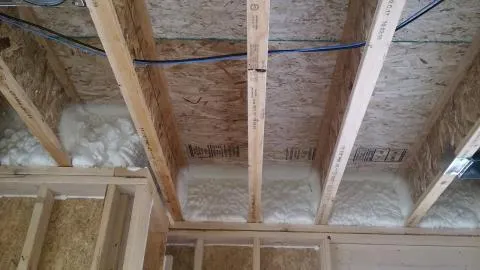
Beneath this platform, there’s a framework of perpendicular supports, or joists, that run the length and span the width of the entire floor. On the first floor of your home, this framework sits squarely on top of a sill that’s fitted to the top of your home’s foundation.
Either end of each floor joist is butted up against two other perpendicular supports called rim joists. Along with the two outermost floor joists, these two rim joists help form the the perimeter, of the floor’s framework. The main job of each rim joist is to provide lateral support for the floor joists.
Hot air is less dense than cool air, so it rises. During the winter, the warm air near the top of a house is pressurized with respect to the outdoors, while the air near the bottom of the house is depressurized. The air at high pressure escapes though cracks, drawing outdoor air into the house through cracks near the bottom of the house. This phenomenon is called the stack effect. If snow melts relatively quickly around the foundation of your house when temperatures are still below freezing, chances are you’re losing heat through uninsulated rim joists.
The reverse happens in summer when hot air outside of an air-conditioned house can push cooler indoor air down from the ceiling and out of cracks in the basement.
In most houses, the only materials standing between rim joists and outside air is sheathing and siding. Many homeowners think that sealing attic air leaks is all it takes to stop the stack effect. But the job isn’t truly complete until you seal basement leaks, too. This is where rim joist spray foam insulation comes in.
Proper insulation along the rim joists of your home’s foundation helps eliminate air leaks and keeps moisture out; it also creates a strong thermal barrier at the base of the building envelope itself. Whole-home benefits include:
- Minimal basement air leakage
- More consistent indoor temperatures year-round
- Lower energy consumption and cost
- Warmer floors in the wintertime
- Better moisture control and indoor air quality
Interested in getting an estimate for your home?
Give us a call 613-922-2259 or send us a message HERE.